
Project
Laser-made electrodes for safer, denser energy storage
GReenBatt aims to show that lasers can produce high-performance anodes from turbostratic graphene and graphene / nanocrystalline silicon in one step, cheaply and with a low environmental footprint.
01Background
Why the electrode matters
Electric vehicles, stationary storage for solar and wind, and portable electronics all need batteries with higher energy and power density. Li-ion batteries and the emerging hybrid Li-ion capacitors currently offer the best balance of energy density, power density and cycle stability. Both still need better materials and simpler manufacturing.
Silicon is an attractive anode material because it is abundant and has a theoretical capacity of 4,200 mAh g⁻¹. Its volume changes sharply during lithiation, however, which pulverises the particles, breaks their contact with the current collector and destabilises the solid-electrolyte interphase. The capacity fades as a result. Making the Si particles smaller, combining them with graphene, or using sub-stoichiometric SiOₓ all ease these stresses.
Manufacturing is the other bottleneck. A battery cell goes through at least ten production steps, even with commercial raw materials: mixing, slurry formation, coating, drying, pressing and further cell preparation. Graphene processed in slurries also restacks irreversibly, which loses active surface area.
GReenBatt addresses three of the five priority areas of the EU SET Plan for batteries: advanced materials, eco-friendly production, and high energy density with fast charging.
02Method
Three laser-assisted processes
Every process runs under ambient conditions with industrial-type lasers, which is what makes the approach cheap, simple and scalable. The laser and the precursor (biomass, polymers, carbides or silicones) together determine the morphology of the graphene.
- A
Simultaneous growth and transfer
Graphene-based films are deposited directly onto the current collector while the precursor (biomass, polymer or carbide) decomposes under a near-IR beam.
- B
Direct growth on the electrode
Precursors pre-deposited on the current collector are converted to graphene in situ. Large spot areas (> 1 cm²) allow very high processing speed.
- C
Highly porous carbide-derived carbons
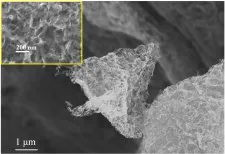
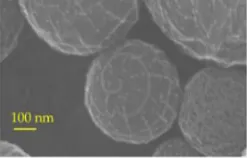
Mid-IR (CO₂) irradiation, suited to carbides and biomass that absorb poorly in the near-IR, yields 3D graphene froths or graphene nanospheres decorated with nc-Si below 10 nm.
 a
(a) 3D graphene froth from SiC decomposition
 b
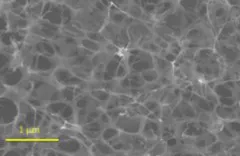
(b) Foam-like graphene scaffold
 c
(c) Graphene nanospheres decorated with 5–10 nm quantum dots
Characterisation
Materials, electrodes and devices are characterised following international protocols where they apply (NPL Good Practice Guide 145 and ISO/TS 21356-1:2021 for graphene). Techniques include Raman mapping, SEM/TEM/HR-TEM, XRD, XPS/UPS and EELS, X-ray micro- and nano-tomography, BET, four-probe and van der Pauw electrical measurements, cyclic voltammetry, galvanostatic charge/discharge and impedance spectroscopy. Cells are assembled in an argon glove box.
03Objectives
Objectives and key performance indicators
Five scientific and technological objectives (STO) and one innovation objective (IO). Where an objective can be measured, it comes with key performance indicators.
STO-1
Understand laser-based direct synthesis and deposition of graphene-based materials onto current collectors
Building on FORTH’s method for simultaneous laser-assisted growth and transfer of graphene, the project studies the underlying mechanisms and applies them to commercial polymers that cannot be graphitised by pyrolysis, and to biomass-derived matter, on rigid and flexible current collectors.
STO-2
Control the morphology, conductivity and porosity of foam-like 3D Gr / nc-Si nanohybrids
Graphene decorated with nanocrystalline Si (and SiOₓ, x < 2) is prepared by pulsed near-IR laser decomposition of low-cost powders rich in Si and C, producing binder- and additive-free electrodes tuned to specific device requirements.
STO-3
Correlate materials properties with electrochemical response
Raman microscopy, XPS/UPS, electron microscopy, diffraction, µ-CT, BET and four-point sheet-resistance measurements are combined with cyclic voltammetry, galvanostatic charge/discharge and impedance spectroscopy.
STO-4
Build and evaluate Li-ion half-cells and hybrid Li-ion capacitors with liquid and solid electrolytes
Gr / nc-Si and Gr / nc-SiOₓ serve as working electrodes in Li-ion half-coin cells. The best-performing nanohybrids become anodes in hybrid Li-ion capacitors, with neat graphene as the cathode.
STO-5
Explore upscaling to roll-to-roll (R2R) digitalised production
An existing R2R pilot line for laser reduction of graphene oxide on flexible substrates, developed by FORTH with a collaborating SME, is extended towards the synthesis of graphene-based electrode materials.
IO-1
Innovation, dissemination and exploitation
Protection of generated knowledge, collaboration with technology-transfer entities, and training of young researchers in fundamental and applied energy research.
04Ambition
EU SET Plan targets
The method does not depend on a particular battery chemistry, so it can also inform post-lithium technologies. The project measures its devices against the following SET Plan targets.
| Fiche | Application | Targets | Horizon |
|---|---|---|---|
| 1.1 | Advanced Li-ion batteries for e-mobility | 400 Wh kg⁻¹ · > 750 Wh l⁻¹ · > 700 W kg⁻¹ · > 1,500 W l⁻¹ · > 15,000 cycles | by 2030 |
| 3.1 | Hybrid Li-ion capacitors/batteries for stationary storage | 40 Wh kg⁻¹ · 12 kW kg⁻¹ · > 1.5 M cycles | by 2025 |
05Innovation
What sets the approach apart
- Time efficiency
- High-yield production with laser technologies already in industrial use.
- Environmental sustainability
- No pre- or post-treatment with harmful chemicals.
- Cost-effectiveness
- No high vacuum or high-temperature chambers; industrial welding and marking lasers are used.
- Uniqueness
- No conventional thermal method such as pyrolysis yields graphene-like structures from these precursors.
- Adaptability
- No manual graphene transfer; direct integration onto any substrate and in-situ patterning.
- Scalability
- High-speed processing over large focusing areas (> 1 cm²) for area or volume production.
06Impact
Expected impact
- New knowledge on electrochemical energy storage materials, especially bio-derived graphene and greener production processes.
- Competitive advantages for Greek and European SMEs in energy storage for PV, stationary applications and electric vehicles.
- Lower carbon emissions and waste from less energy-intensive processes, and less reliance on critical raw materials thanks to abundant silicon.
- Training of young researchers in fundamental and applied energy research.
Collaboration with SMEs that run laser-assisted roll-to-roll pilot lines is meant to move the process from the laboratory towards semi-industrial production.